
Hearing Aid Technology and Innovations: Transforming the Lives of People with Hearing Loss
Joy of Hearing Team
Joy of Hearing Clinical Team
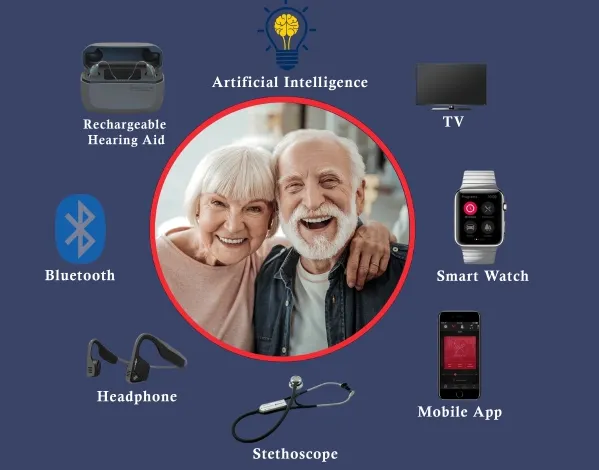
The human auditory system is an incredibly complex physiological structure, relying on the microscopic hair cells within the cochlea to translate acoustic sound waves into electrical impulses. When a patient experiences sensorineural hearing loss—often a result of presbycusis (aging), ototoxic medications, or prolonged noise exposure—these delicate hair cells become damaged. This results in auditory deprivation. The impact goes far beyond simply needing sounds to be louder; it severely distorts speech clarity and drastically impairs the ability to understand conversation in complex acoustic environments.
Untreated auditory deprivation forces the brain to work harder to decode degraded acoustic signals. This increased cognitive load leads to severe listening fatigue. Over time, untreated hearing loss is strongly correlated with accelerated cognitive decline, social isolation, depression, and an increased risk of physical falls due to impaired spatial awareness.
Historically, managing this condition relied on analog amplification, which uniformly increased the volume of all sounds—including distracting background noise. This often led to a frustrating, excessively loud, and uncomfortable listening experience. Modern audiology has entirely transformed rehabilitative care. By utilizing advanced microprocessors and digital signal processing, contemporary hearing aids function as highly sophisticated neuro-prosthetics that analyze, filter, and optimize the acoustic environment in real-time.
The Foundation: Advanced Digital Signal Processing (DSP)
The evolution from analog circuitry to digital signal processing marked the beginning of modern audiological rehabilitation. Digital signal processing involves converting acoustic sound waves into binary code, manipulating that digital information based on complex algorithms, and converting it back into a precise acoustic signal before it reaches the tympanic membrane.
Modern hearing instruments process sound across multiple independent channels or frequency bands. This multi-channel architecture allows audiologists to precisely map the amplification curve to the patient’s exact audiometric profile. For instance, a patient presenting with a high-frequency sensorineural hearing loss will receive targeted amplification strictly in the higher pitches, where critical consonant sounds like /s/, /f/, and /th/ occur. If their hearing is normal in the low frequencies, the DSP leaves those pitches entirely untouched.
Additionally, DSP enables Wide Dynamic Range Compression (WDRC). A damaged cochlea has a narrowed dynamic range—meaning the distance between the softest sound the patient can hear and the loudest sound they can tolerate is severely compressed. WDRC algorithms apply non-linear amplification based on the exact input level of the sound. Soft sounds, like a whisper, receive a substantial boost. Moderate conversational speech receives a moderate boost. Loud sounds, like a siren or heavy machinery, receive little to no amplification, ensuring the output never exceeds the patient’s Uncomfortable Loudness Level (UCL). This precise, non-linear processing perfectly mimics the compression mechanics of a healthy human cochlea.
Artificial Intelligence and Deep Neural Networks
Perhaps the most profound clinical advancement in recent years is the integration of Artificial Intelligence (AI) and Deep Neural Networks (DNN) into the hearing aid microchip. Traditional hearing aids relied on static, pre-programmed mathematical algorithms to manage background noise. While effective to a degree, these algorithms could occasionally suppress speech cues if the vocal frequencies closely resembled the background noise profile.
Today’s AI-powered processors are trained on millions of distinct sound scenes using deep machine learning. The devices continuously scan the surrounding acoustic environment—often up to 500 times per second. They analyze the signal-to-noise ratio, spatial cues, reverberation patterns, and frequency distribution. When the device identifies a highly complex environment, such as a crowded restaurant with poor acoustics, the onboard neural network instantly classifies the soundscape.
The AI then rapidly adjusts the microphone polar patterns, utilizing binaural beamforming. The left and right hearing aids communicate wirelessly, sharing audio data to create a highly focused, narrow beam of sensitivity directed at the primary speaker in front of the patient. Simultaneously, the algorithms actively suppress competing noise from the sides and rear.
Consider a real-world clinical example: A 68-year-old patient with moderately severe sloping hearing loss frequently struggled to hear her family at holiday dinners. The overlapping voices, clattering silverware, and background music created a wall of sound that traditional amplification only exacerbated. Fitted with AI-enabled devices, the processor instantly identifies the primary speech signal and heavily attenuates the surrounding noise. The patient regains the ability to engage actively, vastly reducing her cognitive load and listening fatigue.
Tinnitus Management and Sound Therapy
Sensorineural hearing loss is frequently accompanied by tinnitus—the perception of ringing, buzzing, or hissing in the ears without an external sound source. Advanced hearing technology offers sophisticated tools for tinnitus management. Audiologists can program built-in sound generators to produce broadband white noise, pink noise, or fractal tones (chimes that follow a predictable but non-repeating pattern).
By providing constant, low-level acoustic enrichment, the hearing aids help to mask the tinnitus signal, breaking the negative feedback loop in the auditory cortex and promoting habituation. Specialized algorithms, such as notch therapy, can even isolate the specific frequency of the patient’s tinnitus and reduce amplification exactly at that pitch, training the brain to ignore the phantom sound over time.
Connectivity and the Wireless Ecosystem
Bluetooth Low Energy (BLE) technology has transformed hearing aids from standalone medical instruments into fully integrated communication hubs. Patients can seamlessly pair their devices with smartphones, tablets, and smart televisions. This direct-to-ear streaming bypasses ambient room noise and reverberation entirely, delivering a pristine audio signal directly to the ear canal.
When a patient takes a phone call in a noisy environment, the audio is routed in high-definition stereo to both ears, significantly improving speech recognition scores. Podcasts, audiobooks, and turn-by-turn GPS navigation are all streamed effortlessly.
The emerging Auracast broadcast audio standard represents the next frontier in accessibility. Auracast allows public venues—such as transit terminals, lecture halls, and theaters—to broadcast high-quality audio directly to all compatible hearing devices simultaneously. Instead of relying on aging induction loop systems, a patient sitting in an airport will receive boarding announcements directly into their ears with zero latency and zero interference from background chatter.
Rechargeable Lithium-Ion Technology
For decades, the standard power source for hearing instruments was the zinc-air button battery. These tiny batteries required frequent replacement, often every three to five days. For older adult patients presenting with peripheral neuropathy, osteoarthritis, or diminished fine motor skills, manipulating these minuscule batteries was a constant barrier to consistent use.
The audiology industry has now heavily shifted toward integrated lithium-ion micro-batteries. These rechargeable power cells offer sufficient capacity to support a full 24 hours of operation, easily accommodating the heavy power demands of continuous Bluetooth streaming and AI processing. Patients simply place their devices in a magnetic induction charging dock overnight. This shift eliminates the severe dexterity challenges associated with battery changes and provides a highly sustainable, eco-friendly solution by reducing the disposal of millions of chemical batteries annually.
Miniaturization and Ergonomic Design
Despite the immense processing power, dual microphones, and Bluetooth antennas housed within the chassis, hearing aids have become astonishingly small. Advances in microelectronics have facilitated the development of highly discreet, aesthetically pleasing devices.
The Receiver-in-Canal (RIC) style physically separates the microphone and computer processor (which sit hidden behind the pinna) from the speaker or receiver (which sits deeply inside the ear canal), connected by an ultra-thin, nearly invisible wire. This open-fit design minimizes the occlusion effect—the hollow, booming sensation of hearing one’s own voice—providing a highly natural, transparent sound quality.
For patients seeking absolute invisibility, custom Invisible-in-Canal (IIC) devices are manufactured from a physical impression of the patient’s ear. These devices sit deep within the second bend of the bony portion of the ear canal, completely hidden in the anatomical shadows. These ergonomic improvements play a massive role in reducing the historical stigma associated with wearing medical devices, encouraging earlier clinical intervention.
Integrated Health Tracking and Biometrics
The ear canal provides an exceptionally stable and accurate location for capturing biometric data, far superior to the wrist. Modern hearing aids increasingly function as comprehensive health monitoring wearables. Equipped with advanced 3D accelerometers and gyroscopes, these devices precisely track physical activity, step counts, and overall movement patterns.
Most critically, these sensors enable highly reliable fall detection. If an older adult experiences a sudden fall, the hearing aids detect the specific biomechanical signature of the impact. The system automatically sends an emergency alert—complete with precise GPS coordinates—to designated family members or caregivers via the paired smartphone application. Given the heavily documented correlation between untreated hearing loss, vestibular impairment, and the risk of physical falls, this biometric capability provides profound clinical value and peace of mind.
Tele-Audiology and Remote Patient Care
The integration of smartphone applications has dramatically expanded the scope of clinical care beyond the physical walls of the audiology clinic. Through asynchronous and synchronous remote programming platforms, audiologists can perform precise fine-tuning adjustments without requiring the patient to travel.
If a patient reports that high-pitched sounds like running water are too sharp, or that they are struggling to understand speech in a specific acoustic environment, the audiologist can remotely access the patient’s data logging via a secure, HIPAA-compliant cloud portal. The clinician modifies the frequency response, alters compression ratios, or adjusts the aggression of the noise reduction algorithms, and pushes those programming updates directly to the patient’s app. The patient simply taps to accept the update, instantly applying the new prescriptive settings. This remote capability is immensely beneficial for patients facing mobility restrictions or those residing in rural areas without close access to specialty healthcare.
The Absolute Necessity of Professional Fitting
While over-the-counter (OTC) hearing devices are available, they are intended strictly for perceived mild-to-moderate loss and lack the sophisticated multi-channel processing, custom molds, and deep clinical customization of prescription-grade neuro-prosthetics. The true rehabilitative potential of advanced technology is fully realized only when combined with the medical expertise of an audiologist or hearing healthcare professional.
Clinicians employ Real-Ear Measurement (REM), the absolute gold standard in audiological verification. REM involves placing a microscopic probe microphone deep in the ear canal alongside the hearing aid. This allows the clinician to measure the exact sound pressure level striking the eardrum across all specific frequencies. The resonant properties of every human ear canal are entirely unique. By objectively verifying that the hearing aid is meeting exact prescriptive mathematical targets (such as NAL-NL2 or DSL v5.0), the clinician ensures that soft speech is audible, average speech is perfectly intelligible, and loud sounds remain entirely safe and comfortable.
Technology is simply the vehicle; comprehensive audiological evaluation, precise prescriptive fitting, and ongoing rehabilitative counseling form the bedrock of successful patient outcomes.